La Fuente Santa
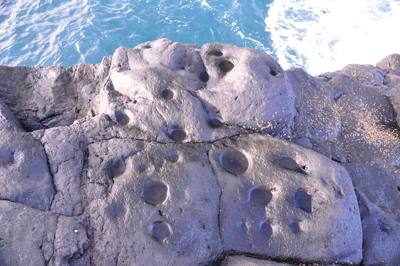
The spring lay at the foot of a high coastal cliff where there was a pebble beach, and there two tidal pools formed which the sick called San Lorenzo and San Blas. Thanks to their names, today we know what the therapies practised there consisted of. While it flowed, in the 16th and 17th centuries, it was visited by illustrious invalids and curious travellers, among whom it is worth highlighting Don Pedro de Mendoza y Luján, 1st Adelantado of the South Seas and the Río de La Plata, founder of the city of Buenos Aires; Don Alvar Núñez Cabeza de Vaca, 2nd Adelantado of the South Seas and conqueror of Uruguay, Paraguay and Argentina; Fray Gaspar de Frutuoso, eminent Portuguese geographer and author of the book Saudades da Terra; Leonardo Torriani, fortification engineer and official at the court of Philip II; and Fray Juan de Abreu Galindo, historian and author of one of the few descriptions of the spring, who called it by the name of Tagragito, the name given to it by the ancient aborigines of the island, the Auarita, which means hot waters.
The 17th century is when it reached its greatest importance. The sick came to the island from all over Europe and America in search of a cure for their ailments, which included syphilis, leprosy, rheumatism, osteoarthritis and any skin disease or the healing of wounds. The water, carried in casks, was taken to Cuba and Antwerp, from where it was sold in small containers. The wealth generated by the water of the Fuente Caliente made the island's per capita income the highest in the Canary Islands and the port of Santa Cruz de La Palma the most visited, and caused the whole southern tip to be named with the toponym of Fuencaliente, as it is still called today. The needs of the sick even led to the founding of a small neighbourhood called Las Indias, because of the wealth that lived there. Such was its fame that it crossed borders, and soon its astonishing cures came to be considered miraculous; that was when it changed its name to Fuente Santa (Holy Spring), becoming the most famous spa in the Atlantic.
The eruption of 1677
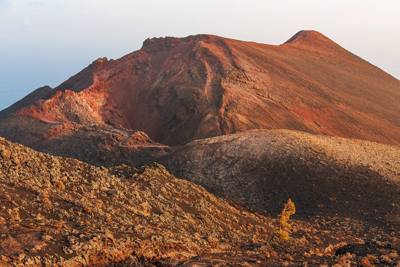
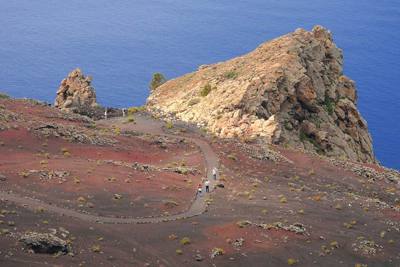
At the height of its popularity, everything ended abruptly. On 13 November 1677, a quarter of an hour after sunset, the earth shook and 23 mouths of Hell opened at the foot of the Montaña de Los Corrales. So begins the account of Nicolás de Sotomayor, in which he tells how the moments of the eruption were lived and the despair that reigned at the danger that the lava flows would bury the legendary spring. After several rivers of lava that diverted north and south of the notches in the cliff at whose foot the pools lay, at last, on 23 November of that same year, ten days after the eruption began, a river of lava headed south towards the point where the cliff that sheltered the spring rose. Nothing could be done: tons of rock buried the pools before the astonished eyes of the islanders and the sick. Never was the despair of an island greater.
The loss of this spring meant the abrupt disappearance of the island's greatest source of wealth. In the first moments a true revolution broke out on the island, in which those in favour of recovering it and those in favour of leaving the spring buried, since God had willed it so, clashed so violently that the Inquisition had to intervene, sending its First Senior Officer of the Holy Office in the Canary Islands, Don Juan Pinto de Guisla, who wrote a report which, together with a watercolour of the moment the spring disappeared, with the volcano in full eruption, is preserved in the National Historical Archive in Madrid.
The rediscovery
For more than three centuries the spring was tirelessly sought. Apart from the first attempt, made only ten years after the spring was buried and led by invalids and islanders who still remembered where it lay, the later attempts did not know the exact spot where the thermal spring was buried. In every case an attempt was made to sink a well which, after passing through the 70 metres of material emitted by the San Antonio volcano, would reach one of the two pools of San Lorenzo or San Blas. So Abreu Galindo relates, and the following generations: different drilling proposals, none of them successful.
There was also the question of the great stone cross, or an elongated excavation, which according to tradition and the writings of Juan de Paz and Antonio Joseph Palmerini marked the place where the spring lay buried.
Since then, and for 328 years, the search for the spring marked the life of the islanders, until in 2005 a team of engineers from the Directorate-General for Water of the Government of the Canary Islands was commissioned to carry out the search by boring a truly singular piece of engineering: a small-section tunnel 200 metres long which, set at sea level, made it possible to reach the foot of the cliff where the pools of San Lorenzo and San Blas once lay and the water of the thermal spring flowed.
Once the Fuente Santa was found, the Oliver Rodés Laboratory in Barcelona analysed its waters and discovered the true reason for the miraculous cures of old: the water was sodium chloride and carbonated, the jewel of spa waters, the most sought after in Spain and never found; there are only two with this composition in Europe, Nauheim and Royat, in Frankfurt and Vichy, in Germany and France respectively.
It can be said that the waters of the Fuente Santa are unique of their kind in Spain and the best in Europe for their high content of salts, their temperature and their carbon dioxide. In the future, the aim is to establish a thermal spa in the area to make use of them.