Archaeology
Las Cazoletas de Mar
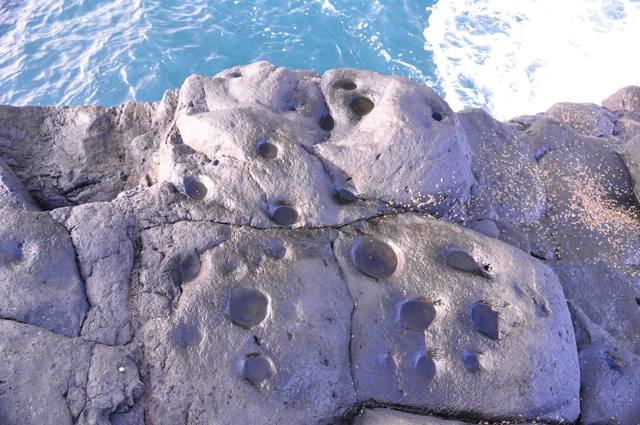
Fuencaliente is the municipality of La Palma that occupies the southern tip of the island, in such a way that it is the only one with a coastline on both sides, eastern and western. It should therefore come as no surprise that the influence of the sea can be felt in every archaeological site in the municipality. Precisely on that edge where land and sea meet, some 140 such places are found on the island of La Palma, 20 of them on the coasts of Fuencaliente. This can hardly be a trivial matter when the overall count approaches 4,000 cup-marks (cazoletas).
Fuencaliente is the municipality of La Palma that occupies the southern tip of the island, in such a way that it is the only one with a coastline on both sides, eastern and western. It should therefore come as no surprise that the influence of the sea can be felt in every archaeological site in the municipality. Precisely on that edge where land and sea meet, some 140 such places are found on the island of La Palma, 20 of them on the coasts of Fuencaliente. This can hardly be a trivial matter when the overall count approaches 4,000 cup-marks (cazoletas).
They must have been made with mixed techniques of striking or percussion followed by scraping, hollowed out and polished stone on stone, given the absence of metal. As for their forms, circular and conical cup-marks predominate, though some oval ones can also be seen. They show a variety of diameters, ranging from 5 up to 25 or 30 cm; their depth varies from roughly 5 to 30 cm. They normally form groups, from a few (some isolated or in pairs) to formations of several dozen that can exceed a hundred, usually combining different diameters and depths.
The most outstanding groups on the coast of Fuencaliente are: Punta de La Tora, Punta y Baja de Las Escaleras, La Colmena, Guincho Grande or Punta del Viento, Las Cabras, La Garza I, II and III, Punta de El Cabezo, Malpique, Porís de Puntalarga, El Ombligo, El Fondito I and II, Punta del Hombre, La Zamora de Abajo, the Porís de La Zamora and the Punta del Banco. Only from there is communication with the transcendent possible.
Symbolic thought in general, and religious thought in particular, allude to and derive from a cosmogony. The idea implies that inhabitable space is built in the manner of a microcosm that reflects decisive aspects of the cosmological scheme. Of all these sites, three stand out for their number of cup-marks and for their striking, transcendental manifestation of the sacred:
1. Guincho Grande or Punta del Viento, which holds some 130 cup-marks. The point stretches out towards the sea along a line that connects it with the place where the sun rises during the equinoxes. At the opposite end, a relevant astronomical phenomenon for the Awara population coincides with it: the emphatic appearance of the full Moon during the Major Northern Winter Lunistice — part of the lunar cycle that occurs every 18.6 years — over the highest point of Montaña del Viento.
2. Las Cabras, with some 200 cup-marks carved at the water's edge. Every summer solstice, the sun can be seen setting behind the proud Montaña del Lajío. It is also visually striking how the shadow, seen from that mountain, gradually takes over the Punta de Las Cabras, where the cup-marks are concentrated.
3. Porís de Puntalarga. It holds a group of some 50 cup-marks, carved at the exact spot for determining the arrival of the indigenous equinoxes, at the moment when the position of the sunrise coincides with the lofty Roque Teneguía.
The sea was a significant source of food, and it seems natural that it should be thanked with a ritual of communion and reciprocity, placing solid food and/or pouring milk into the cup-marks at low tide so that the forces, spirits or goddesses of the sea would symbolically receive the human food, collecting it when the high tide came in. In turn, the sea was venerated as a maternal divinity whose properties had the power to heal, cleanse and purify — where balance is found, and the very seed of the origin of life. Reciprocity creates a mirror between humans and the gods or spirits.
Miguel A. Martín González